


Every week, get the latest curated signals on news, uncommon insights and perspectives that help you become a better builder and thinker. Paid subscribers get full access to all newsletters, deep-dives, essays, field guides, and curated podcast Q&A notes.
Quick request: if you haven’t already, please fill out our anonymous survey. I’m making this standalone request as we’ve been getting a lot of great feedback (thank you!) and we’re now seeing if there’s strong interest in helping you get access to particular deals & discounts. The following question has been added to the survey:
What tools are you using or would like to use that would be valuable to you if you had access to discounts and/or limited complimentary access?
Answering this will allow us to work with our partners to ensure we can give you the best deals.
Thank you, and now back to regular programming.
This past week, I had the chance to read an interesting post from Greg Brockman, who is currently the President and co-founder of OpenAI, about what the future of compute might look like. It’s a long one, so I didn’t want to paste the whole thing. Read it if you can.

I’m pretty convinced it’s directionally correct—we’re fully transitioning into a compute-based economy.
Also, as an addendum to his post, there has been an interesting cultural phenomenon taking place across the tech community with plenty of folks throwing around the buzzword “tokenmaxxing”, which sounds like crypto gibberish, but when you unpack it, the impacts of it will become noticeable in the coming years. It essentially means we’re about to aggressively trade human op-ex for compute cap-ex.
Basically, we're not only optimizing for human capital, but also optimizing for compute efficiency.
I wanted to explore what all of this means for all of us on the ground, as well as across startups (including venture capital), to see if all of this makes sense.
What’s tokenmaxxing? This is all about leveraging AI to the n-th degree. Tokenmaxxing refers to the practice of optimizing every single dollar around maximizing AI token output and compute efficiency. Instead of hiring an extra engineering pod to build out a new product feature or scale up a support team, you can allocate that $$$ straight to dedicated GPU clusters to automate those functions entirely.
In other words, employees from Meta to Salesforce (whether leadership knows about it or not) are gauging, measuring, and comparing token usage against one another, in an effort to motivate people to use AI in their day-to-day work.
To back this up even more, there are some interesting examples of where this is already happening:
Meta’s “Claudeonomics”: a Meta employee recently spun up (and then quietly shut down) an internal leaderboard that gamified token usage. Top users earned titles like “Token Legend” and “Cache Wizard”.
The $150k Coding Bill: In March, reports confirmed a single Anthropic user racked up a $150,000 monthly bill using Claude Code for intense, parallelized coding workflows.
Nvidia’s 50% Rule: Jensen Huang stated that he’d be “deeply alarmed” if a $500,000 engineer wasn’t consuming at least $250,000 worth of compute fuel annually to amplify their output.
The CEO Mandate: Cleo CEO Barney Hussey-Yeo said that “everyone at Cleo is tokenmaxxing,” formally giving engineers $2,000/month token budgets while he personally burned through $36,000 doing it himself.
Obviously, this is quite controversial, because there is no direct causal proof that simply using more tokens leads to better quality output and productivity improvements across the org.
In case you’re wondering what the heck a token is, then you should check out this piece titled: Understanding the AI Landscape (in 2026) that I whipped up a few months ago. Hope it helps.

Here’s a short excerpt from the piece about tokens.
Prompts (and Tokens)
This is the actual raw text. The literal instructions you type in to steer the model. It’s the absolute most basic form of control logic we all possess in the Generative AI space. You feed it text, and you get text back.
But it’s more than just typing a query into a chat box.
Prompting has become the new command line of the 21st century.
It’s basically how you program a non-deterministic system. The language you use, the specific phrasing, the examples you provide — they fundamentally shift the probabilities of what the model outputs next.
It is fragile, yes. But it’s a really good starting point for every single AI interaction.
Crucially, when you send a prompt, the model doesn’t read English words. It breaks your text down into Tokens, which are sub-word fragments or chunks of characters. Tokens are the true foundational “currency” of AI compute. Every prompt you write is converted into a sequence of tokens. The length of this sequence determines your compute cost, the latency of the response, and exactly how much of your extremely valuable Context Window you are eating up before the model even begins to actually “think.”
Why this matters. If you’re a founder, an engineer/developer, or a non-technical operator, I get this strong sense that the rules of the game are quickly changing when it comes to your output.
For Founders: capital is going to be deployed very differently. Historically, if you raised a $5M seed round, 70% of that went to headcount, swanky offices, and probably bloated growth marketing budgets. Well, this may not be the case any longer. Now, there is a growing trend where the vast majority of capital will now flow directly into compute. Funnily enough, I’ve started to observe an interesting (and growing) trend of startups beginning to include their token economics (“tokenomics”) into their pitch decks.
For Venture Capital: fundamentally, the nature of venture risk is changing. Traditional startup risk used to be execution risk (can the team actually build it?) and market risk (does anyone want it?). Both of these still hold very true. However, now, VCs are potentially adding intense compute risk as another pillar. VCs (whether they like it or not) have to face the reality that they’re underwriting companies that they will most likely burn through plenty of $$$ in compute as they get to product-market-fit. I’m seeing funds restructure their own thesis to ensure that their portfolio companies have preferential access to compute.
For Engineers: the value is shifting way faster than the models themselves, because the era of just being a “good” engineer is no longer valid. The new status quo is that companies now want (and also need) to hire engineers who are AI-pilled. This means recruiting people who understand the tools and know how to use them effectively in whatever scenario and context that it requires of them. Simply put, if you can master orchestration and architectures, optimize prompt compilation, and understand exactly how to squeeze every drop of efficiency out of a foundation model, you’re essentially writing your own ticket.
For Operators & Leaders: leveraging AI is now so pervasive that I don’t think there should be any excuses not to use it, and this goes for people outside of engineering. I know it might sound like I’m an AI maximalist, but considering what we’ve seen thus far, there are so many use cases of where AI has been diffused into society via the application layer. Note-taking, audio transcribing, image generation, emails, presentation decks, and the list keeps going. Similarly to engineers, knowing how to use these tools will certainly set you apart from your peers. The punchline here is that AI won’t necessarily replace you, but it’ll be the people who know how to use AI that will take your job.
What’s driving this…obviously, there’s the relentless acceleration of model capabilities and reasoning skills, but the real fuel driving the tokenmaxxing craze is the sheer economic necessity of it. If you’re a startup (or even an established company), the last thing you want to do is get left behind, especially when your competitors are not leaving anything on the table.
You should read this piece from Microsoft on the Frontier Firm. It’s the idea that companies that will have the highest chance of success will be those that embrace AI and integrate it deeply into their core operations.
It feels like only yesterday that Marc Andreessen penned “software is eating the world”. For the better part of a decade, that was very true. We operated in a time when the primary constraint on business growth was ambition and talent availability. The limiting factor was always: how fast could you hire talented knowledge workers to build, sell, implement, and support software?
We eventually reached “peak SaaS”. Essentially, this was a point where every possible niche enterprise workflow had three to five different, well-funded venture-backed competitors vying for the same market share. It was a game of inches, won entirely by who had the better sales team or the cleaner UX/UI, etc.
Now? We’re sort of entering an era where intelligence itself has been fundamentally commoditized and digitized.
We’ve converted over from human-maxxing to token-maxxing, and the axis of the technology industry has pivoted.
But two questions remain:
Will all of this lead to better quality and productivity gains, or just slop on steroids?
How will all of this compute come into being as we continue to struggle with the demand and supply of energy?
Some questions to ponder…
ICYMI:
Last Week’s Releases

Thanks for reading so far 🙏🏼
If you liked the content so far, you can check out our full TWS archive, plus more in-depth content: under the hood and field guides.
I’d love to get some feedback. If you have some time, fill out the following survey.
Want to get in front of our audience? You can partner with us.
Upgrade to the premium version for full access to all content.

The King is dead? Meta might overtake Google in global digital ads in 2027: I reckon trends like this indicate where the culture is shifting, and right now, it’s moving towards social media as the new way of getting information (albeit fake or not).
Google search will always be crushing it, but with things like AI overviews, etc., it’s becoming much harder for people to go directly to the link when there’s so little friction in just reading what AI spits out at the beginning of the page.
With social media, you literally have to scroll (by design) down your feed, where you’ll come across the ads. Even if there was an AI overview of your Instagram feed, I don’t think you’ll want it. The dopamine hit is the scrolling in and of itself.

OpenAI leaks a memo (not another one…): the memo takes direct shots at Microsoft (the hand that has been feeding them from the beginning) and, of course, Anthropic. It just shows the immense pressure they’re under right now...and I don’t think it’s going to get better. The one tidbit that stuck out to me is the fact that OpenAI is both acknowledging their frayed relationship with Microsoft, but also acknowledges that game recognizes game - Anthropic is here to play.
The fact that Anthropic has been able to build itself into a generational company in just 5 years ($30B ARR!) is pretty incredible, and it did so by building “quietly”. When I say “quietly,” I mean just by staying out of the press for the wrong reasons.
The other thing is the GOATED brand they have built by just delivering product and features of immense value, i.e., Claude Code, Cowork, Dispatch, Channels, etc. The word “Claude” is not part of the zeitgeist, and that’s now an easy thing to do. Don’t get me wrong, OpenAI has great products too, like Codex, but it just doesn’t hit the same.
When your models are basically on par with each other, how the heck do you stand out? Well, I think Anthropic found a gap in enterprise, but more importantly, it positioned itself so uniquely, different, and diametrically opposite to its competitors, that it’s finally winning...for now.
NASA is trying to build a nuclear-powered spacecraft: it’s called the SR-1, and the plan is to hit Mars by 2028. It uses nuclear electric propulsion to bypass the limits of just solar and chemical rockets. You should watch this video, which shows that nuclear propulsion is the next step in achieving interstellar travel. But, even so, it’ll still take 2,000 years to reach our nearest star: Proxima Centauri. Baby steps.
Atomic Tessellator out of New Zealand raises at $50M val to invent rare earth alternatives using quantum physics and AI. Obviously, breaking any semblance of China’s grip on the supply chain is a massive geopolitical priority. It’s pretty cool to see capital funneling into these digital labs to solve very physical bottlenecks. Also, quite neat that a small NZ startup is building something like this that could have global implications on the entire minerals and AI supply chain.
Apple is building smart glasses: After the Vision Pro completely face-planted with consumers, the company is reportedly testing four different display-less smart glasses designs for 2027, and obviously, to rival Meta’s successful Ray-Bans.
I’m glad Apple finally came to its senses on this. The Vision Pro was genuinely an engineer’s dream project. It had all the bells & whistles and had some decent product-market-fit. It was too far ahead of its time. But also for Apple, it just wasn’t profitable enough to make a long-term bet on this. The irony is that Meta’s more “simpler” glasses were an instant hit. Eventually, I suspect the glasses will become more advanced. However, right now, the mass market wants something that has a sense of style as well as being pragmatic. It’ll be interesting to see what Apple can cook up on this because building aesthetic (and functional) hardware is in their DNA.
Allbirds (the shoe company) has done a 180 pivot into AI compute: the company just dumped its struggling shoe business and renamed itself to “Allbirds AI”.
This could be one of the greatest pivots in business if this goes right...
Basically, neoclouds are these specialized providers that focus on niche, high-demand workloads (like AI compute), instead of competing with the huge might of AWS or Azure. They can be super profitable if they lock down the right specialized hardware and purpose-build for those exact use cases.
This could genuinely be a good move, so massive kudos to them for considering something this audacious.
Most people think it’s the most ludicrous 180 move of all time, but if you think about it... there’s actually some really interesting overlaps.
Outside of just raw tech, building neoclouds presents massive physical challenges around logistics, global supply chain, procurement, and shipping, so a direct-to-consumer physical goods company might have some pedigree here. Also, from an energy standpoint, one of the founders has a deep background in renewable resources, which might actually come in really handy, and that might genuinely become a huge competitive edge for them
The media is mostly just dunking on this right now, but not enough people are asking: what if this actually works? I’m going out on a limb and saying I reckon this might actually have legs.
I really believe it’s far better to bet that something is even remotely possible with a slim chance of success, rather than instantly writing it off as impossible and then realizing you were completely wrong in the end.

Things are stepping up at Google. Although I’m not sure if this will be a net positive. As you can imagine, there will certainly be a big question about his own personal world views and how that may (or may not) affect his influence on his work.

Interesting take on AI agents from Aaron (Founder of Box) at the enterprise level. Worth a read.

This is a particularly good episode between Dwarkesh and Jensen. Most of Jensen’s podcast appearances have been particularly one-sided in the sense that the podcast host has more or less been in favor of agreeing with everything Jensen (and Nvidia) has to say. However, in this episode, there were a few questions that pushed back against Nvidia’s decision to sell compute to China. The conversation turned a bit spicy, but it was all in good fun.
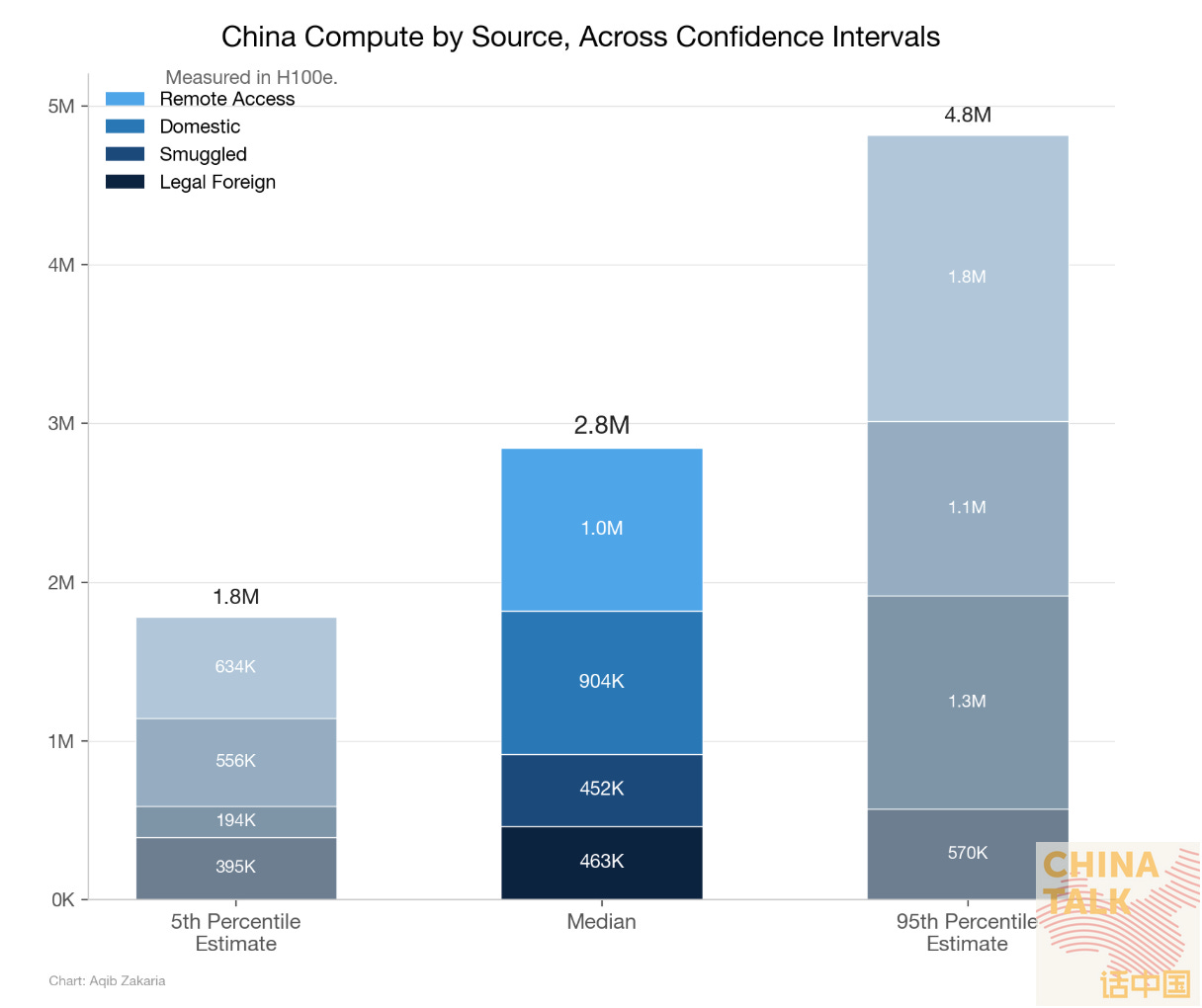
Speaking of compute…you should read this interesting piece from ChinaTalk about how much compute China actually has.
For context, Epoch AI estimates the cumulative compute by leading chip designers to total 20 million H100e. This suggests that China has access to about an eighth of the world’s compute — ChinaTalk
If you liked this, please consider sharing this with your network. Thanks for your support!